In 2012, a housing lottery was organized to allot homes to mill workers in Mumbai. However, concerns soon emerged regarding irregularities in the beneficiary list. It was discovered that several names were duplicated, while others included individuals who were ineligible, such as workers who had left service prior to 1982. These discrepancies triggered widespread objections and protests, eventually leading to the filing of a public interest litigation before the Bombay High Court.On June 28, 2016, the High Court directed that a committee headed by a retired judge be constituted to examine and resolve the matter. The government led by Devendra Fadnavis, which had assumed office after the Congress–NCP administration, complied with the court’s instructions and initiated corrective measures to address the irregularities. Following these efforts, 5,052 homes were ultimately allotted to eligible mill workers.
Even after the change in government in 2019, Fadnavis continued to monitor and pursue progress on the second phase of the mill workers’ housing scheme. When political developments in 2022 brought him back into office as Deputy Chief Minister, the project regained momentum.In line with the High Court’s directives, Fadnavis had personally engaged in efforts to resolve the long-pending concerns of mill workers. During the first phase, he placed a statement before the Legislative Assembly on April 12, 2016, outlining the solutions identified and reaffirming the government’s commitment. As assured, 5,052 housing units were made available to mill workers across Mumbai and the MMRDA region, fulfilling a key promise of the administration.
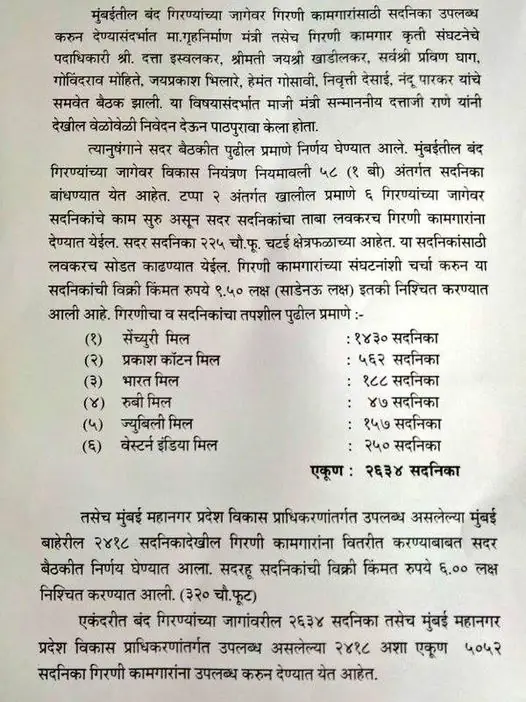
In an address to the Legislative Assembly, Devendra Fadnavis outlined the details of the housing initiative for mill workers. He stated that construction was underway for 2,634 residential units on the premises of six defunct textile mills in Mumbai, and that possession would be handed over to eligible workers shortly. Each of these units, measuring 225 square feet, was priced at ₹9.50 lakh for beneficiaries.Additionally, plans were finalized for 2,418 homes in the Mumbai Metropolitan Region Development Authority (MMRDA) areas. These units, each spanning 320 square feet, were made available at a concessional rate of ₹6 lakh.
The distribution of the 2,634 Mumbai-based units included 1,430 at the Century Mill site, 562 at Prakash Cotton Mill, 188 at Bharat Mill, 47 at Ruby Mill, 157 at Jubilee Mill, and 250 at Western India Mill—collectively totaling 2,634 homes within the city. Alongside this, 2,418 units in the MMRDA region were earmarked for mill workers. Altogether, the scheme provided for 5,052 houses—2,634 in Mumbai and 2,418 in nearby metropolitan areas—addressing a long-standing demand of the city’s mill workforce.The Fadnavis administration further assured that no eligible mill worker would be left without housing. Those who were unsuccessful in the initial lottery were to be accommodated in subsequent phases. To support this commitment, provisions were made in Mumbai’s development plan to allocate maximum possible land for affordable housing. A portion of these units was reserved specifically for mill workers who had missed out in the first draw. In parallel, there were plans to construct nearly 11 lakh homes across the broader MMRDA region to expand access to low-cost housing.
A house for every mill worker!
Nearly 2.5 lakh workers were once employed across Mumbai’s textile mills. When these mills shut down, many workers were left without stable livelihoods and were unable to secure homes of their own. Devendra Fadnavis had assured that such affected mill workers would be provided housing support, and steps were subsequently taken to honor that commitment. Residential units were made available to eligible beneficiaries in Mumbai as well as in nearby areas such as Thane, Kalyan, and Navi Mumbai.
To ensure transparency and fairness, MHADA launched a special verification drive covering around 1.5 lakh mill workers and their legal heirs who had not been selected in earlier lottery rounds. During this process, documents were scrutinized through both online and offline methods to confirm authenticity and eligibility. Based on this verification exercise, homes were allotted to qualified workers and their heirs.Through these measures, the assurance given by Fadnavis during his tenure as Chief Minister regarding housing for mill workers was carried forward and implemented.
Houses were distributed to the workers of Bombay Dyeing and Srinivas Mills
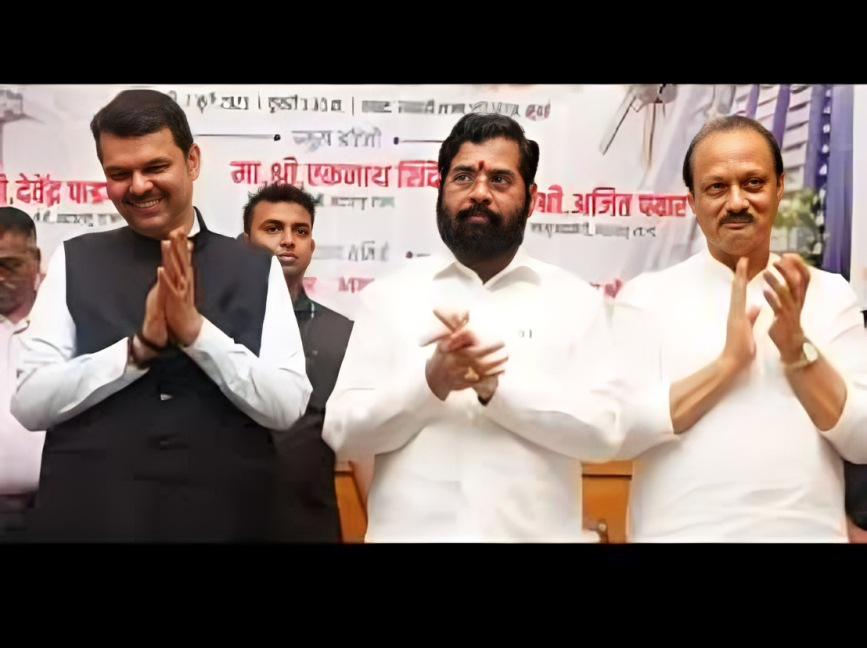
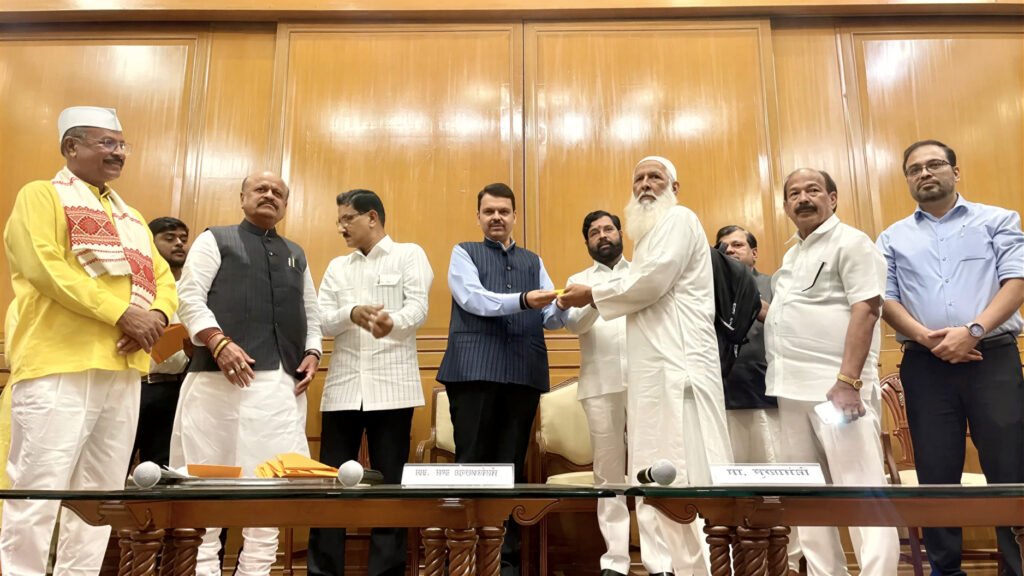
A total of 251 workers from Bombay Dyeing and Srinivas Mills were handed over the keys to their new homes in the presence of Eknath Shinde, Ajit Pawar, and Devendra Fadnavis. The distribution ceremony for beneficiaries under the second phase was held on July 7, 2023, at Sahyadri Guest House. With this allotment, 10,247 out of the total 13,760 identified mill workers have so far received homes constructed by MHADA.In parallel, a panel headed by MLA Sunil Rane and MLA Kalidas Kolambkar was constituted to address pending housing concerns of mill workers. The committee is expected to scrutinize and confirm the eligibility of nearly 4,000 additional applicants in the near future.
To facilitate further housing development, MHADA has earmarked around 43,000 hectares of land across five locations in Thane district for the construction of residential units for mill workers. The state government has reiterated its commitment to ensuring that all eligible mill workers are provided housing under the scheme.