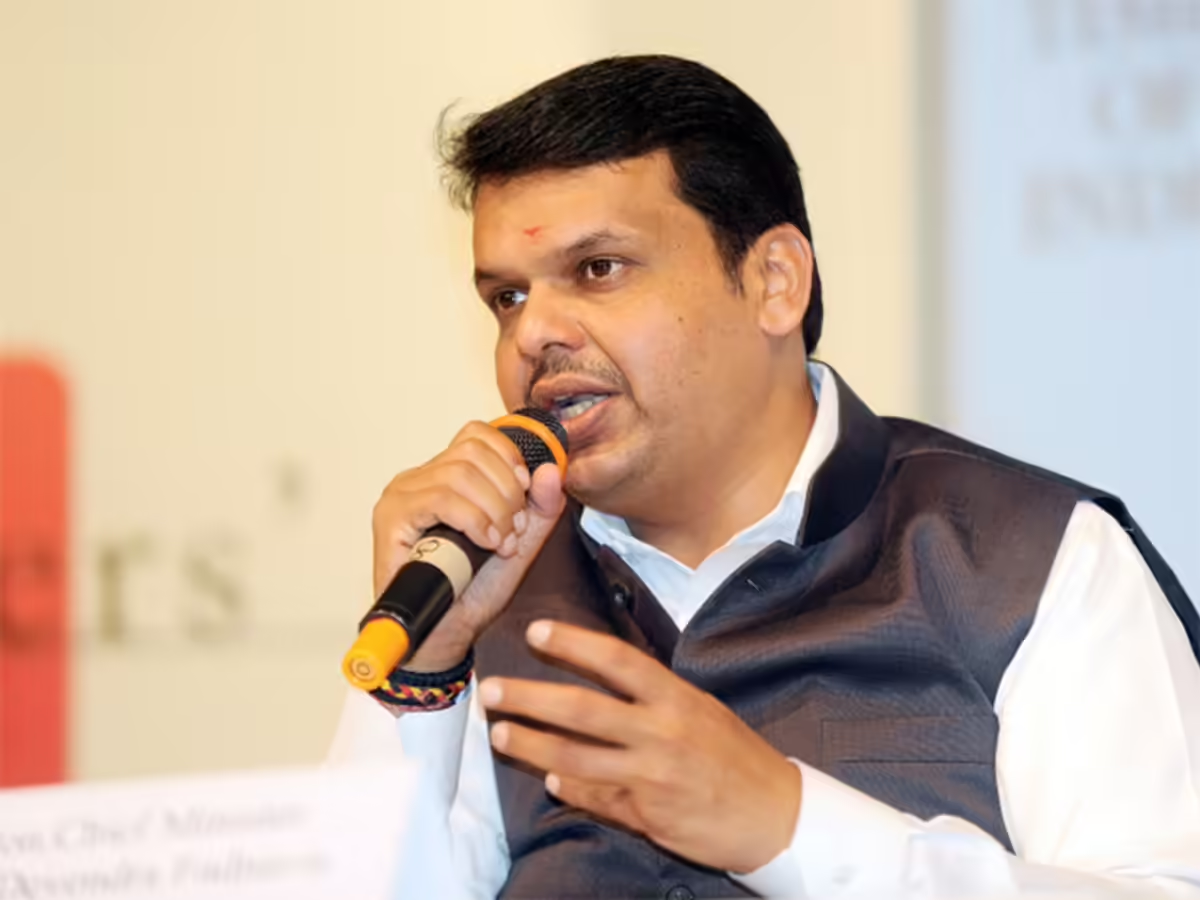
For many senior politicians, social workers, and journalists, the memories of the Emergency still evoke pain. A large number of them were jailed, subjected to harsh treatment, or forced to remain underground while resisting what they viewed as unconstitutional and authoritarian measures of the Union government in 1975. These measures included the postponement of elections, curbs on civil liberties, strict press censorship, and other actions taken under the leadership of Indira Gandhi. The repercussions were not limited to those arrested; their families also endured prolonged uncertainty, financial strain, and emotional trauma that altered the course of their lives.Devendra Fadnavis, whose father Gangadharrao Fadnavis was detained during that period, was personally touched by those turbulent events. His father was reportedly taken from their home in the early hours of the morning and imprisoned for an indefinite duration. As the nation observes fifty years since the Emergency declared on June 25, 1975, Fadnavis resolved to pay tribute to those who stood firm in defense of democratic principles.
The 1975 Emergency has been described by historian Gyan Prakash as a “lawful suspension of laws,” imposed to silence opposition and consolidate power. Allegations of electoral irregularities, reliance on a compliant bureaucracy, and disregard for judicial directions were among the issues that intensified political tensions at the time. The crisis deepened on June 12, 1975, when the Allahabad High Court found Indira Gandhi guilty of electoral malpractice and barred her from holding office for six years. Amid mounting political unrest, President Fakhruddin Ali Ahmed, acting on the advice of the Prime Minister, proclaimed a national Emergency under Article 352 of the Constitution.Widely regarded by many as one of the darkest phases in India’s democratic history, the Emergency is remembered by several political groups as a grave assault on democratic values. June 25 continues to be observed as a somber reminder of that period, with 2025 marking fifty years since its imposition.
Devendraji’s refusal to study at Indira Convent School
The Emergency declared in 1975 led to widespread crackdowns across the country, with numerous raids, detentions, and imprisonments targeting political figures, activists, and members of the press who opposed the government led by Indira Gandhi. Voices of dissent were systematically curbed during this period.At that time, Devendra Fadnavis was still a child. His father, Gangadharrao Fadnavis, was arrested due to his association with the Rashtriya Swayamsevak Sangh in Nagpur and his active involvement with the Bharatiya Jana Sangh, the political predecessor of today’s Bharatiya Janata Party.
An interesting episode from that time reflects the emotional impact the arrest had on young Devendra. He was then studying at Indira Convent School in Nagpur. Disturbed by his father’s detention, he reportedly chose not to continue at a school bearing the name of the Prime Minister he believed responsible for the arrest. Firm in his stance, he insisted on changing institutions and was eventually enrolled in Saraswati Vidyalaya in his locality.This incident may appear as childhood defiance, but it also revealed an early sense of conviction. Inspired by his father’s example, Fadnavis later became associated with the RSS and gradually emerged as an activist engaged in social and civic causes before formally entering politics. Given this background rooted in protest and civil rights advocacy, it is unsurprising that he seeks to honor those who endured imprisonment and hardship while defending democracy during the Emergency.
The decision to honor those jailed during the 1975 Emergency
The Emergency proclaimed on June 25, 1975, and withdrawn on March 31, 1977, subjected the nation to nearly 21 months of intense political and social strain. During this phase, civil liberties were severely curtailed, preventive detentions were carried out without trial, public gatherings were restricted, and an atmosphere of anxiety prevailed across the country. The impact was not limited to political activists; ordinary citizens also faced hardships. In several cases, individuals lost their employment merely on suspicion, pushing their families into financial and emotional distress.Yet, despite the repression, resistance movements continued. Many have described this phase as a “second freedom struggle,” reflecting the determination of those who opposed authoritarian rule. In recognition of their sacrifices, Devendra Fadnavis resolved to acknowledge individuals who had been imprisoned for defending democratic values.
During his first tenure as Chief Minister, he presented a proposal in the Cabinet meeting held on January 2, 2018, to extend financial assistance to such individuals. A nine-member subcommittee was subsequently formed under the chairmanship of the then Revenue Minister to finalize the framework. The panel recommended a pension scheme for those jailed for participating in protests against the 1975 Emergency, or for their spouses in cases where the individual had passed away.Under the scheme, a monthly honorarium of ₹10,000 was sanctioned for those imprisoned for more than one month, with ₹5,000 allocated to their surviving spouses after their demise. For those detained for less than a month, the monthly assistance was fixed at ₹5,000, while their spouses were made eligible for ₹2,500 per month after their death. The resolution was duly implemented. Later, on June 25, 2019, while responding to a query in the Legislative Assembly, Fadnavis stated that 3,267 beneficiaries had received honorariums under the scheme up to that point.
Scrapping of the scheme by the MVA and revival by the Mahayuti
Following the 2019 Assembly elections, the mandate was initially in favor of the BJP–Shiv Sena alliance. However, the political equation shifted when Uddhav Thackeray parted ways with the BJP and formed a new coalition with the Congress and the NCP to assume office as Chief Minister. After coming to power, the newly formed Maha Vikas Aghadi government reviewed and put on hold several initiatives launched during Devendra Fadnavis’ earlier tenure. Among the decisions reversed was the cabinet-approved scheme to provide honorariums to individuals who had been imprisoned during the Emergency. In a cabinet meeting held on June 2, 2020, the Thackeray-led administration formally withdrew the resolution. As a result, the scheme remained inactive between 2019 and 2022.
A significant political development occurred again in mid-2022, leading to the formation of the Mahayuti government by the BJP–Shiv Sena coalition. With Eknath Shinde as Chief Minister and Fadnavis serving as Deputy Chief Minister, the cabinet, in its meeting on July 14, 2022, resolved to reinstate the honorarium scheme for those jailed during the Emergency. Subsequently, a government resolution dated July 28, 2022, was issued to operationalize the revived program. Through this step, Fadnavis realized his objective of formally recognizing and supporting individuals who had suffered imprisonment during the 1975 Emergency.