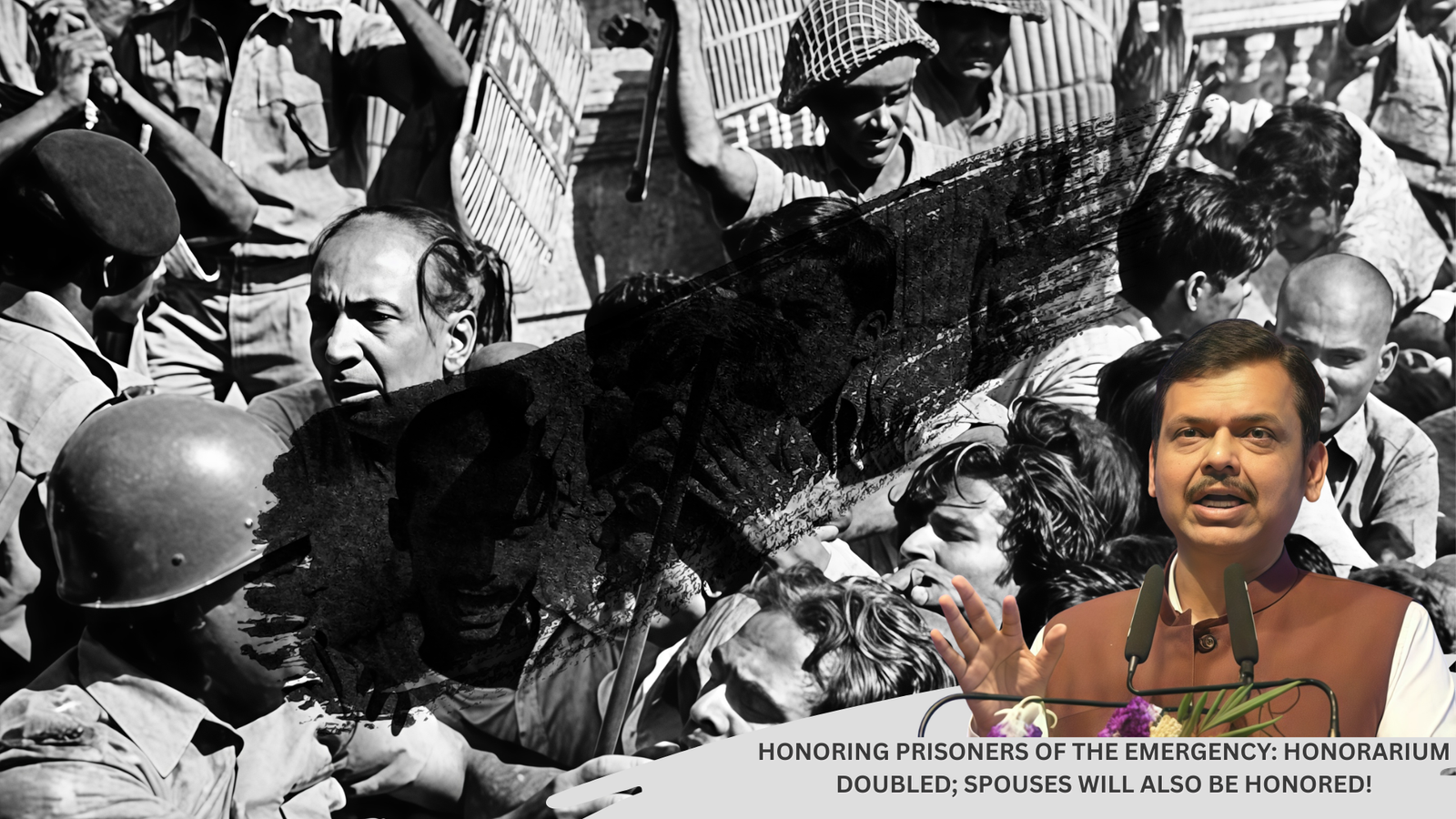
Marking the sacrifices endured by political workers who were jailed while defending democracy during the Emergency, the Devendra Fadnavis-led administration has announced an increase in their financial assistance.Individuals who were imprisoned for more than one month during the Emergency period will now receive a monthly honorarium of ₹20,000. In the event of their demise, their spouses will be entitled to a monthly pension of ₹10,000.Additionally, the state government has resolved to ease the documentation requirements needed to verify and process claims under this scheme.
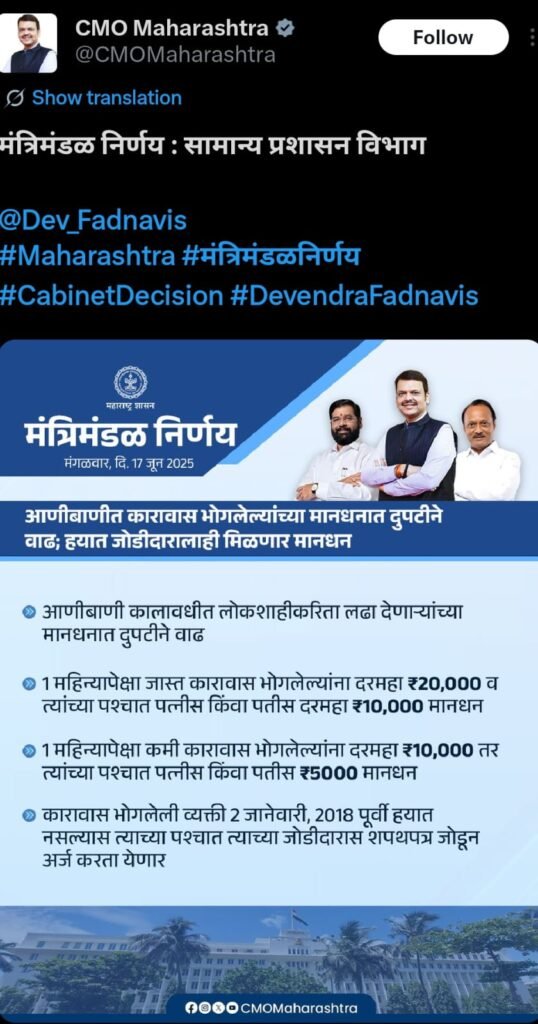
x.com/CMOMaharashtra/status/1935027893853372481?s=20↗
Honoring prisoners for democracy during the Emergency
June 25, 1975, remains one of the bleakest chapters in India’s democratic journey. On that day, the then Prime Minister, Indira Gandhi, proclaimed a nationwide Emergency, ushering in a 21-month period during which constitutional safeguards were curtailed. Civil liberties, freedom of speech, political dissent, and the basic rights of citizens were heavily restricted.Throughout this phase, leaders of opposition parties, activists, members of the press, and even ordinary citizens were taken into custody. The impact of the Emergency was not merely political but deeply personal for many families across the country.Devendra Fadnavis shares a direct family connection to that turbulent era, as his father, Gangadharrao Fadnavis, was among those imprisoned. Beyond this personal history, the widespread suppression of democratic principles, harsh crackdowns on protestors, and the hardships endured by their families continue to inspire him to acknowledge and pay tribute to those who sacrificed their freedom in defense of democracy.
A special policy was decided through a cabinet subcommittee
Devendra Fadnavis set up a cabinet-level subcommittee with the objective of paying tribute to individuals who had been jailed during the Emergency period. Acting on the recommendations of this panel, the government introduced a dedicated policy on July 3, 2018, aimed at extending financial support to former detainees.Under the framework of this policy, those who had spent one month or more in prison during the Emergency became eligible for a monthly honorarium of ₹10,000. After their passing, their spouses were entitled to receive ₹5,000 per month. In cases where imprisonment was for less than a month, the monthly assistance was fixed at ₹5,000 for the individual and ₹2,500 for the surviving spouse.To ensure smooth execution of the scheme, district magistrates were empowered to assess and confirm eligibility on the basis of a sworn affidavit, simplifying the verification process and reducing procedural hurdles.
Decision on the honorarium revoked and reinstated
When the Maha Vikas Aghadi government assumed power in 2019, several programs introduced during Devendra Fadnavis’ earlier tenure were either discontinued or kept in abeyance. Among the decisions reversed was the scheme that granted monthly financial assistance to individuals imprisoned during the Emergency. On June 2, 2020, the Aghadi administration scrapped the honorarium policy, arguing that it had been driven by political considerations.However, the Emergency was far more than a partisan episode; it represented a troubling and oppressive phase in India’s democratic history. Recognizing those who resisted authoritarianism and endured imprisonment during that time is, in essence, a tribute to democratic values themselves—something that ought to transcend party lines and remain a duty of any government.With this perspective, after the alliance returned to power in Maharashtra in 2022, Fadnavis moved to restore the financial assistance. On July 14, 2022, the honorarium scheme for democracy activists jailed during the Emergency was reinstated, reaffirming the state’s commitment to acknowledging their sacrifices.
Policy Reforms and Increase in Honorarium
In 2024, the Mahayuti alliance returned to power in the state, with Devendra Fadnavis once again assuming office as Chief Minister. During this tenure, he announced a decision to increase the honorarium granted to individuals who had been imprisoned during the Emergency, effectively doubling the earlier amount.The revision was intended not merely as a financial enhancement but as a stronger expression of respect for those who had defended democratic freedoms during one of the most challenging periods in the nation’s history.In addition, the government broadened the scope of the scheme to make it more inclusive. Under the updated provisions, spouses of detainees who had passed away prior to 2018 were also made eligible to submit applications and receive benefits.
June 25, 2025, marks fifty years since the proclamation of the Emergency—a milestone that serves as both a reminder of a difficult chapter in India’s democratic journey and a tribute to the resilience of democratic ideals. The day stands as a symbol of resistance against any curbs on free speech, fundamental rights, and constitutional values.In this spirit, Devendra Fadnavis has taken the initiative to formally acknowledge and support those who stood against authoritarian rule and contributed to the preservation of democracy, extending honorariums as a gesture of respect for their sacrifices.
How many times has India been under an Emergency?
An emergency is an exceptional and serious situation that impacts the entire country or a particular region, declared when normal governance cannot function effectively. During such periods, special powers are vested in the central government and the President to manage the crisis. The President proclaims an emergency on the advice of the Union Cabinet.The Indian Constitution provides for three kinds of emergencies: National Emergency, Constitutional Emergency (popularly known as President’s Rule), and Financial Emergency. To date, India has witnessed the imposition of a national emergency on three occasions.The first was declared in October 1962 following the Chinese aggression against India, and it continued until January 1968. The second national emergency was announced in December 1971 amid the conflict with Pakistan. Subsequently, on June 25, 1975, a third national emergency was declared across the country, even though the 1971 Emergency was still in force. This period extended for nearly 21 months. Eventually, on March 21, 1977, both the 1971 and 1975 Emergencies were withdrawn.Among these, the Emergency imposed in 1975 is considered the most controversial and widely criticized. The date of its announcement is often remembered as a dark day for Indian democracy. Then Prime Minister Indira Gandhi justified the proclamation on the grounds of threats to national security. However, during this time, fundamental rights and civil liberties of citizens were severely restricted, leaving a lasting impact on the democratic fabric of the nation.